


Cancer Drug Testing could be transformed by this new paper based platform: Spheromatrix

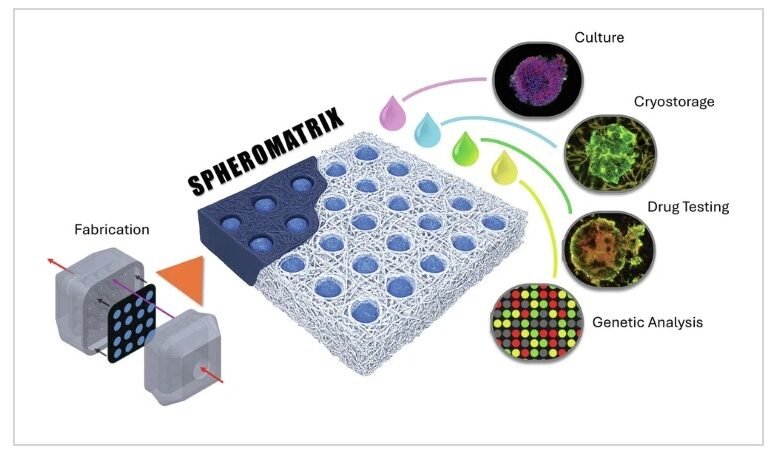
Researchers at New York University Abu Dhabi (NYUAD) have developed Spheromatrix, a simple and low-cost technology that enables tumor models to be grown, frozen, and stored for future use in cancer drug testing. The study on development and validation of this technology was recently published in Nature Microsystems & Nanoengineering.
Three-dimensional (3D) in vitro tumor models are increasingly recognized as essential tools in preclinical oncology because they offer enhanced physiological relevance compared to traditional two-dimensional (2D) cultures. These complex systems better recapitulate the tumor microenvironment, including spatial gradients in nutrients and oxygen, improving the reliability of drug response assessment and holding potential for patient-specific treatment strategies.
Despite their advantages, conventional 3D cell culture methods, such as hanging-drop techniques and scaffold-based systems are often limited by challenges in scalability, cost, standardization, and operational complexity, which hinders their adoption in high-throughput drug screening.
The Spheromatrix is an innovative paper-based platform designed for scalable spheroid generation, long-term preservation, and parallelized drug evaluation that addresses this critical gap.
The Spheromatrix system integrates wax-patterned hydrophilic microwells, called U-wells, with a custom-designed, 3D-printed microfluidic device known as the Spherobox. This design enables precise, reproducible cell loading and supports the formation of a large array of uniform tumor spheroids. The fibrous architecture of the paper substrate mimics native tissue structure and facilitates efficient fluid absorption and transport via capillary action, ensuring adequate nutrient delivery and waste removal crucial for cell viability and growth.
The platform’s components were rigorously optimized: Whatman Grade 2 filter paper, which offered the most uniform wax diffusion, was selected as the substrate, and lamination was incorporated to enhance mechanical stability and minimize the risk of cross-contamination. Furthermore, testing revealed that larger 1.0 mm U-wells sustained the highest levels of cell proliferation and metabolic activity.
The versatility of the Spheromatrix was validated across a panel of six cancer cell lines, including U87 glioblastoma, MCF7 breast cancer, and PC3 prostate cancer, all of which formed viable, metabolically active spheroids.
While most cancer cell lines exhibited exponential proliferation, the non-cancerous MRC5 lung fibroblast line showed a notable decline in viability and clustering, which was attributed to the paper substrate’s lack of essential extracellular matrix (ECM) components required for fibroblast attachment and proliferation. However, all cancer cell lines successfully recovered and maintained high viability and epithelial integrity, effectively mimicking the in vivo tumor microenvironment.
A cornerstone of the Spheromatrix is its robust cryopreservation capability, which supports long-term preservation and subsequent re-culture. This feature is vital for generating pre-formed, “ready-to-use” 3D tumor model biobanks.
Drug testing on cryopreserved and non-cryopreserved U87 glioblastoma spheroids confirmed consistent cytotoxic effects of both cisplatin and temozolomide (TMZ) as single agents, with drug sensitivity being preserved post-thaw. Crucially, the combination of cisplatin and TMZ amplified the cytotoxic outcomes, underscoring the platform’s reliability for assessing combination therapies.
In summary, the Spheromatrix platform provides a practical, cost- and space-efficient solution for generating, storing, and screening 3D tumor models. By overcoming the limitations of conventional systems in terms of scalability and accessibility, the platform offers a valuable tool for advancing personalized oncology, accelerating drug discovery, and establishing large-scale spheroid biobanks.
Reference Source
Glia, A., Deliorman, M., Sukumar, P. et al. Spheromatrix: a paper-based platform for scalable 3D tumor model generation, cryopreservation, and high-throughput drug assessment. Microsyst Nanoeng 11, 219 (2025). https://doi.org/10.1038/s41378-025-01077-0