

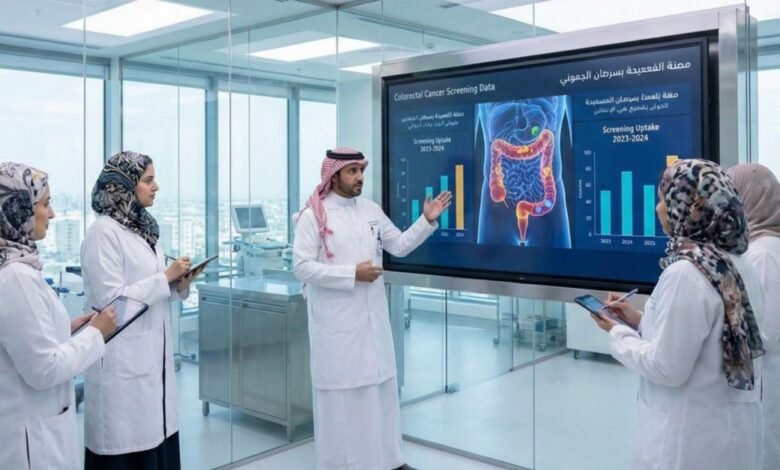
A recent has revealed a “concerningly low” rate of colorectal cancer screening in Saudi Arabia, despite the disease being the most common cancer among Saudi men and the third most common cancer among women.
The study, which surveyed 573 adults aged 40 and older across all Saudi regions, found that only 12.7% had ever undergone a colonoscopy, and only 19.5% had completed a fecal occult blood test (FOBT). These figures fall significantly below global benchmarks, where adherence rates in other countries often exceed 75%.
The study was conducted by a team of researchers from Imam Mohammad Ibn Saud Islamic University (IMSIU) and King Saud bin Abdulaziz University for Health Sciences (KSAU-HS) between May and June 2025 who assessed adherence to guidelines and identified barriers to Colorectal Cancer screening in Saudi Arabia. The most common identified barriers were:
- 49.9% participants believed screening is unnecessary if they feel healthy.
- 36.6% reported anxiety about the procedure as a major deterrent.
- 35.3% reported lack of knowledge.
- 19.5% individuals avoided testing due to shame or modesty, particularly women.
Awareness of Colorectal Cancer Screening in Saudi Arabia was very low and more than half of the respondents rated their own knowledge as a 1 out of 10. While over 60% of participants held university degrees, only 18.3% could actually name a screening method.
Regional Disparities
Participants in the Southern region were nearly nine times more likely to have undergone FOBT than those in the Northern region. Meanwhile, only 38.7% had heard of screening, and most lacked even basic CRC knowledge in the Western region. Researchers attributed these regional disparities to differences in population density, community health mobilization campaigns, engagement of primary healthcare centers and physicians in promoting non-invasive tests and the concentration of tertiary healthcare facilities in larger urban centers.
Potential for Change
The study found that while only 21.7% had received a recommendation for CRC screening, 84.5% of participants said they would screen if suggested by a physician and 77.5% did not doubt the effectiveness of CRC screening. These findings demonstrate a strong latent willingness to screen.
Recommendations
The authors recommend establishing a nationwide screening initiative in Saudi Arabia and establishing a National Registry for Colorectal Cancer Screening in Saudi Arabia to systematically track adherence and outcomes.
Strategies for improving screening uptake include:
- Correcting Misconceptions: Culturally appropriate public campaigns to emphasize that screening is for healthy people without symptoms and addressing fears associated with the procedure.
- Physician Advocacy: Encouraging doctors to proactively recommend screening for all patients over 45. Integrate CRC reminders into electronic health records EHRs.
- Tailored Outreach: Using mobile screening units to reach regions where access is currently low.
- Promote Non-invasive Home Testing – Using non-invasive FIT kits that can be mailed to homes to bypass fear and shame and overcome hesitancy toward colonoscopy.
The authors recommend designing region-specific interventions that address local cultural, socioeconomic, and healthcare system differences rather than adopting a one-size-fits-all approach.
Article edited and summarized by Diya E H
Reference Source: Alamer, I. A., Altuwaijri, R. A., Alfraih, S. F., Alotaibi, B. S., Alqahtani, M. A., Alqasim, S. A., & Bin Abdulrahman, K. A. (2025). Assessing adherence and identifying barriers to colorectal cancer screening in the adult general populations of Saudi Arabia: A nationwide cross-sectional study. International Journal of Environmental Research and Public Health, 22(9), 1386. https://doi.org/10.3390/ijerph22091386
Read more regional research news on cancer https://menamedicalresearch.com/news/category/cancers/