

Colorectal Cancer in Oman – Exploring associations between epidemiological risk factors

Colorectal Cancer in Oman is the most prevalent cancer among males and the third most common cancer among females. This multicentre case control study, conducted at Sultan Qaboos University Hospital and the Royal Hospital in Muscat, provides a detailed examination of the factors driving Colorectal Cancer (CRC) in Oman.
Researchers highlight a concerning epidemiological shift in Oman and the wider Arab world: an increasing incidence of CRC in patients under the age of 50, which differs from global age distributions.
Methodological Approach
The study analyzed 332 Omani adults (166 cases with histologically confirmed adenocarcinoma and 166 controls with normal colonoscopies) between September 2024 and July 2025. Data were primarily extracted from hospital information systems and supplemented by telephone interviews to capture missing lifestyle data. The research used a questionnaire adapted from the Colon Cancer Family Registry, which was translated into Arabic and back-translated to ensure accuracy.
Key Findings and Risk Stratification
Multivariable logistic regression identified several independent predictors that significantly increase the likelihood of CRC:
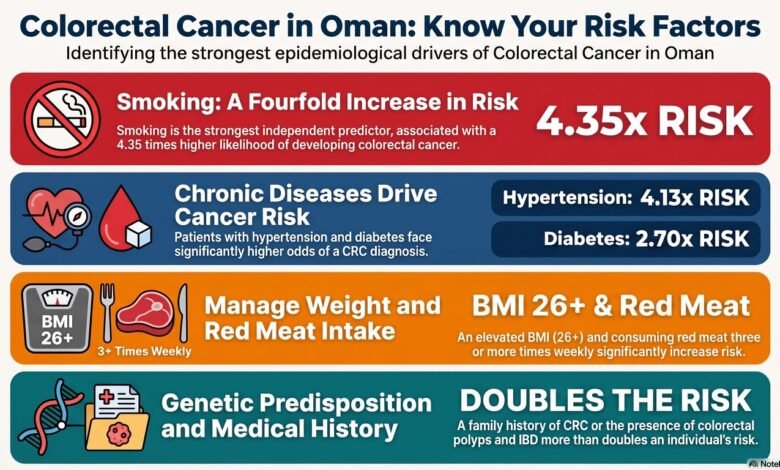
- Smoking and Hypertension: These emerged as the strongest predictors. Smokers faced a fourfold increased risk (aOR: 4.35), a critical finding given that smoking prevalence in Oman reached 8.0% in 2020. Hypertension was similarly associated with a fourfold risk (aOR: 4.13), potentially due to a clustering of cardiometabolic comorbidities.
- Metabolic Factors: Rapid economic growth in Oman has led to lifestyle shifts, with nearly 66% of the population now overweight or obese. The study found that a BMI of 26 kg/m² or higher more than doubled CRC risk (aOR: 2.42). Additionally, Type 2 diabetes mellitus was associated with nearly triple the risk (aOR: 2.70), a significant concern as approximately 15.7% of Omanis are diabetic.
- Genetic and Clinical History: A family history of CRC encompassing first-degree relatives (parents, siblings, children) and second-degree relatives (grandparents, uncles, aunts)—doubled the risk (aOR: 2.10). Clinical conditions like colorectal polyps (aOR: 2.61) and inflammatory bowel disease (aOR: 3.48) also showed strong independent associations.
- Dietary Habits: While not an independent predictor in the final multivariable model, frequent red meat consumption (three or more times per week) was significant in univariable analysis. Researchers noted that traditional Omani cooking methods like charcoal grilling, shuwa, and mandi expose meat to intense heat and smoke, which are known human carcinogens.
Clinical Insights and Tumor Characteristics
The study noted that among confirmed cases, tumors were most frequently located in the sigmoid colon (33.7%), followed by the rectum (19.9%) and the right colon (19.3%).
Limitations and Future Directions
The authors acknowledge limitations, including potential recall bias regarding self-reported dietary and smoking habits. Furthermore, because the study was conducted at tertiary referral centers, the sample may represent more complex clinical presentations or younger patients than the general Omani community.
The findings underscore the necessity of a risk-based screening program in Oman. The authors recommend integrating smoking cessation, weight management, and the rigorous control of chronic metabolic diseases into national healthcare strategies to mitigate the rising burden of colorectal cancer.
Source: Rehman S, Shalaby A, Al- Busafi SA, et al. Exploring associations between epidemiological risk factors and colorectal cancer in Oman: a case–control study. BMJ Open 2026;16:e117673. DOI: https://doi.org/10.1136/ bmjopen-2026-117673
For more regional research on cancers, visit https://menamedicalresearch.com/news/category/cancers/