

UAE Newborn Screening Study Reveals High Prevalence of G6PD Deficiency and Metabolic Disorders

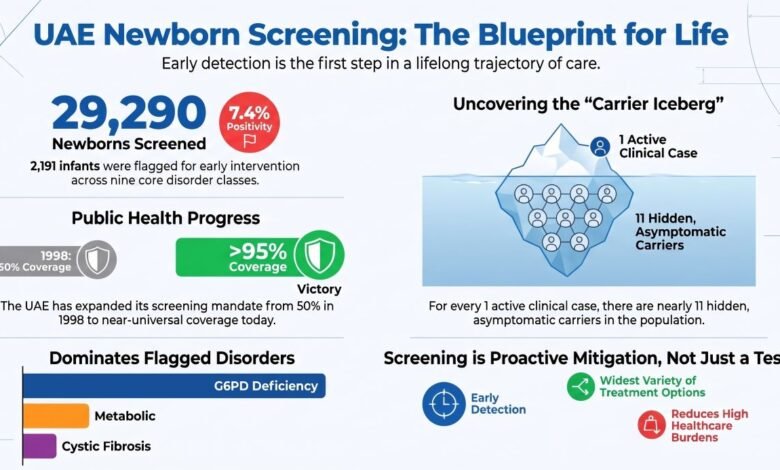
A UAE Newborn Screening Study analyzed data from 29,290 newborns screened between 2021 and 2023, and found that 7.4% of the cohort tested positive for one or more disorders, underscoring the critical nature of early intervention in the region.
This retrospective cross-sectional study published in Frontiers in Pediatrics has provided the first comprehensive analysis of nine classes of disorders detected through the United Arab Emirates (UAE) newborn screening (NBS) program.
Key Prevalence Data
The study, which utilized data from the National Reference Laboratory (NRL) across 20 hospitals, identified glucose-6-phosphate dehydrogenase (G6PD) deficiency as the most prevalent condition, with a screening positivity rate of 5,278 per 100,000 newborns. Following G6PD, the highest prevalence rates were observed for:
- Cystic Fibrosis: 566 per 100,000.
- Acylcarnitine Disorders: 518 per 100,000.
- Aminoacidopathies: 505 per 100,000.
Endocrine disorders were also significant, with congenital adrenal hyperplasia (CAH) and congenital hypothyroidism (CH) detected at rates of 160 and 116 per 100,000, respectively.
The Burden of Hemoglobinopathies
Inherited blood disorders represent a major focus of the UAE’s public health strategy. Alpha-thalassemia was identified as the most common hemoglobinopathy. Beyond confirmed cases, the study highlighted a substantial carrier burden, with 2.3% of newborns identified as carriers. Sickle cell (HbS) traits were particularly prominent, occurring in 1,338 per 100,000 screened infants. Researchers emphasized that identifying these carriers is vital for genetic counseling and future reproductive planning.
Methodology and Regional Context
The screening employed advanced analytical platforms, including Tandem Mass Spectrometry (MS/MS) for metabolic profiles and High-Performance Liquid Chromatography (HPLC) for hemoglobin variants. The authors postulate that the high prevalence of these autosomal recessive conditions is likely linked to high rates of consanguinity within the local population.
Clinical Implications and Future Directions
While the results demonstrate the success of a program that now covers 95% of newborns in the UAE, the researchers noted that many results reflect “screening positivity” rather than definitive clinical diagnoses. For instance, G6PD figures likely include heterozygous females who may not manifest severe symptoms.
The study concludes that newborn screening alone is insufficient without long-term multidisciplinary management involving geneticists, pediatricians, and counselors. The findings advocate for the establishment of structured national registries and more robust confirmatory testing protocols to transition from early detection to comprehensive life-long care.
Reference Source:
Shafique K, Raza A, Naushad A, Hussain F, Walid D, Wareth L, El-Hattab AW, Bedair RN, Al Dweik R andSadier NS (2026) A retrospective cross-sectional study on newborn screening and prevalence of disorders among UAE population. Front. Pediatr. 14:1788876.
DOI https://10.3389/fped.2026.1788876
Read more on Regional Public health News https://menamedicalresearch.com/news/category/public-health/