

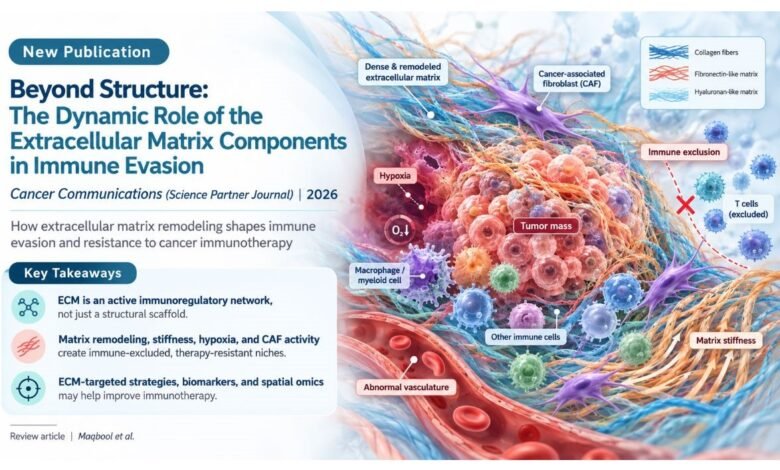
A review study on the role of extracellular matrix in cancer immune evasion published in Cancer Communications, provides a timely and comprehensive perspective on how the extracellular matrix (ECM) actively shapes immune evasion in cancer. Titled “Beyond Structure: The Dynamic Role of the Extracellular Matrix Components in Immune Evasion,” the article moves beyond the traditional view of the ECM as a passive structural scaffold and presents it as a dynamic immunoregulatory network that influences tumor progression, immune-cell behavior, and response to therapy.
The review explains how changes in ECM composition, architecture, and mechanical properties can create an immunosuppressive tumor microenvironment and cause cancer immune evasion. Collagen reorganization, proteoglycan-dependent chemokine sequestration, fibroblast-driven matrix stiffening, abnormal crosslinking, and altered matrix degradation can restrict the movement and function of cytotoxic immune cells. These changes contribute to spatial immune exclusion, impaired T-cell infiltration, T-cell dysfunction, altered cytokine and chemokine signaling, and increased resistance to anticancer immune responses.
Cancer-associated fibroblasts, tumor-associated macrophages, matrix metalloproteinases, and hypoxia-related pathways are discussed as important contributors to this process. The review also highlights how abnormal ECM remodeling can compress blood vessels, disrupt immune-cell trafficking, impair antigen presentation, and reinforce tumor-promoting signaling through mechanotransduction and metabolic reprogramming.
Importantly, the article places strong emphasis on translational opportunities. It critically evaluates ECM-targeted therapeutic strategies, including approaches aimed at modifying matrix stiffness, remodeling pathways, fibroblast activity, and ECM-associated signaling, particularly in combination with immune-checkpoint blockade and other immunotherapies. The authors also stress the importance of biomarker-guided patient stratification to identify tumors that may be most likely to benefit from ECM-directed interventions to control cancer immune evasion.
The review further discusses emerging technologies that are transforming the study of the tumor microenvironment, including spatial transcriptomics, proteomics, advanced matrix imaging, and circulating ECM-derived biomarkers. These tools may improve understanding of spatial immune exclusion, support treatment selection, and enable monitoring of matrix remodeling and therapeutic response.
Overall, this work provides a mechanistic and translational framework for understanding the ECM as an active driver of immune escape rather than simply a structural feature of tumors. By integrating tumor biology, immunology, mechanobiology, and therapeutic development, the review highlights new opportunities for designing more effective ECM-informed cancer immunotherapies.
Published in August 2026, the article brings together current mechanistic evidence and translational strategies in an accessible framework that may be useful to researchers working across cancer biology, tumor immunology, precision oncology, and therapeutic development. It also underscores the need to view matrix biology as part of the therapeutic landscape when addressing immune resistance in solid tumors.
Source: Maqbool M, Surendranath A,Baba SK, Jawwad T, Elfaki I, Mir R,Kumar R, Uddin S, Haris M, Macha MA,et al. Beyond Structure: The DynamicRole of the Extracellular MatrixComponents in Immune Evasion.Cancer Commun. 2026;46:Article0045 https://DOI: 10.34133/cancomm.0045
For more regional research on cancers, visit https://menamedicalresearch.com/news/category/cancers/