

Tumor Associated Macrophages as Therapeutic Targets in NSCLC (Non-Small Cell Lung Cancer)

The role of Tumor Associated Macrophages as Therapeutic Targets in NSCLC (Non-Small Cell Lung Cancer’s) immune environment is the topic of recent review article published in Frontiers in Immunology by researchers from Abu Dhabi University. The article focuses on the involvement of tumor-associate macrophages in resistance to immune checkpoint inhibitors (ICIs).
Although immune checkpoint inhibitors (ICIs) have improved outcomes for some patients, many tumors are unresponsive or eventually develop resistance. The authors consider Tumor Associated Macrophage (TAMs) in NSCLC to be a major factor in this resistance since they affect T-cell infiltration, antigen presentation, angiogenesis, metabolism, tumor growth, and immune suppression.
A key argument is that TAMs cannot be properly understood through the traditional M1/M2 classification. Instead, they exist along a functional spectrum shaped by their origin, location, metabolic environment, and exposure to tumor-derived signals. Tissue-resident alveolar macrophages and monocyte-derived macrophages can develop distinct states. Single-cell and spatial analysis have discovered CXCL9+/CXCL10+, SPP1+, C1Q+, FN1+, LAM/TREM2+, and other populations.
Macrophages that are CXCL9+ are connected with interferon signalling, antigen presentation, the recruitment of cytotoxic T-cells, and better responses to PD-1/PD-L1 blockade. On the other hand, SPP1+, C1Q+, and TREM2+ macrophages are often found in hypoxic or metabolically altered regions and are linked to T-cell exclusion, impaired antigen presentation, angiogenesis, immune checkpoint resistance, and poor prognosis.
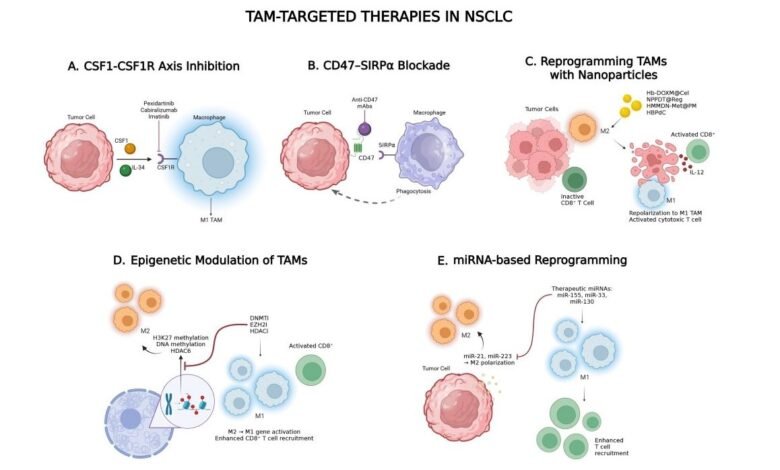
The review assesses several therapeutic strategies. Inhibitors of CSF1-CSF1R aim to reduce TAM survival and recruitment, but their clinical effectiveness has been limited by compensatory recruitment of other suppressive myeloid cells, incomplete depletion of tissue-resident macrophages, and liver toxicity. CD47-SIRPα blockade attempts to restore macrophage phagocytosis by disrupting the tumor’s “don’t eat me” signal, but such approaches usually have to be combined with antibody therapy directed against the tumor, chemotherapy, or immune checkpoint inhibitors, and can lead to anemia and other side effects.
Other strategies involve the use of nanoparticles for drug delivery, the manipulation of microRNA, metabolic and epigenetic reprogramming, and the use of engineered or chimeric antigen receptor macrophages which can deliver cytokines or directly phagocytosing tumor cells.
The authors stress that TAM-targeted therapy faces major challenges. Macrophages can rapidly return to immunosuppressive states when exposed to hypoxia, lactate, adenosine, IL-10, TGF-β, and other tumor-derived signals. The dense, hypoxic nature of tumor tissues also hinders drug delivery.
The review concludes that effective treatment will likely require a biomarker-guided, combination of therapies targeting TAM plasticity, compensatory pathways, and immune checkpoint inhibitors.
Source: Saldana SFA, Abdulrab ND and Raza A (2026) Tumor-associated macrophages in the tumor immune microenvironment of non-small cell lung cancer. Front. Immunol. 17:1738437. https://doi.org/10.3389/fimmu.2026.1738437
For more regional research on cancers, visit https://menamedicalresearch.com/news/category/cancers/