

Epigenetic Signatures of Intergenerational Exposure to Violence – Study on three generations of Syrian refugees

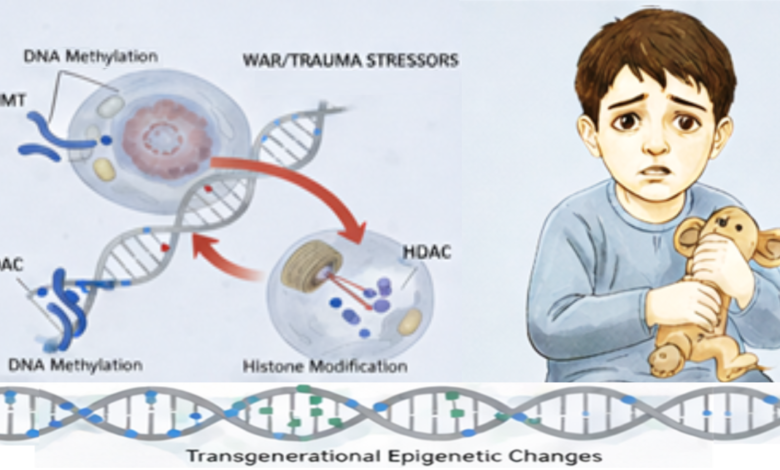
The devastating consequences of war are typically measured in terms of displacement and physical harm. However, a groundbreaking study on three generations of Syrian refugees has discovered epigenetic signatures of intergenerational exposure to violence showing that the scars of violence may be written into the very DNA of those affected.
Published in Scientific Reports, the study investigates how exposure to war-related trauma influences DNA methylation (DNAm), a key epigenetic mechanism that regulates gene expression without altering the genetic code itself.
Researchers assessed 131 participants from 48 Syrian families currently residing in Jordan. They study utilized a unique design to isolate different types of developmental exposure:
- Direct Exposure: Individuals who personally lived through war.
- Prenatal Exposure: Children who were in utero while their mothers were exposed to violence.
- Germline Exposure: Grandchildren whose grandmothers were pregnant with the children’s mothers during the conflict.
By comparing these groups to a control group of Syrians with no war exposure, the team used an Epigenome-Wide Association Study (EWAS) to identify specific differentially methylated positions (DMPs) in the genome.
Key Findings are as follows:
- Biological impact of trauma can be passed down to future generations. 35 significant DMPs were found to be associated with trauma. 14 of these were linked to germline exposure, while 21 were associated with direct exposure. This marks the first report of a germline DNAm signature of violence in humans.
- There is a “common epigenetic response” to violence that persists across different developmental stages. 32 of the 35 identified sites showed the same directionality of change across all three types of exposure. This suggests
- There is a dose-response relationship to trauma and increased trauma events leads to more pronounced shifts in DNA methylation.
- Epigenetic age acceleration – While no specific DMPs were uniquely associated with prenatal exposure, the researchers discovered that children prenatally exposed to war exhibited significant epigenetic age acceleration. This means their biological age appeared more advanced than their chronological age. This finding highlights the womb as a critical period where environmental stressors can fundamentally alter a child’s biological trajectory.
These findings support the “Developmental Origins of Health and Disease” (DOHaD) hypothesis, suggesting that early-life adversity “primes” the epigenome for future health outcomes. Ultimately, this research underscores that the impact of war is not just a historical event but a biological legacy that continues to shape the health of generations to come.
Article edited and summarized by Dr Anam Beg
Reference Source: Mulligan, C. J., Quinn, E. B., Hamadmad, D., et al. (2025). Epigenetic signatures of intergenerational exposure to violence in three generations of Syrian refugees. Scientific Reports, 15:5945. https://doi.org/10.1038/s41598-025-89818-z