

Expanded Premarital Screening in UAE – Outcomes of Capacity Building Workshops for Physicians

Premarital screening in UAE is a critical public health strategy for mitigating hereditary disorders in the local United Arab Emirates (UAE) population, where consanguineous marriages account for approximately half of all unions. However, the effective implementation of expanded PMS programs relies heavily on the expertise of healthcare professionals, many of whom lack specific training in genetic counselling.
To address this gap, a recent cross-sectional study conducted by researchers from Department of Health, Abu Dhabi and United Arab Emirates University evaluated the impact of capacity-building workshops on primary care physicians in the UAE. Prior to these workshops, only 25% of the participants had received formal training in premarital genetic screening, highlighting a significant gap in professional education.
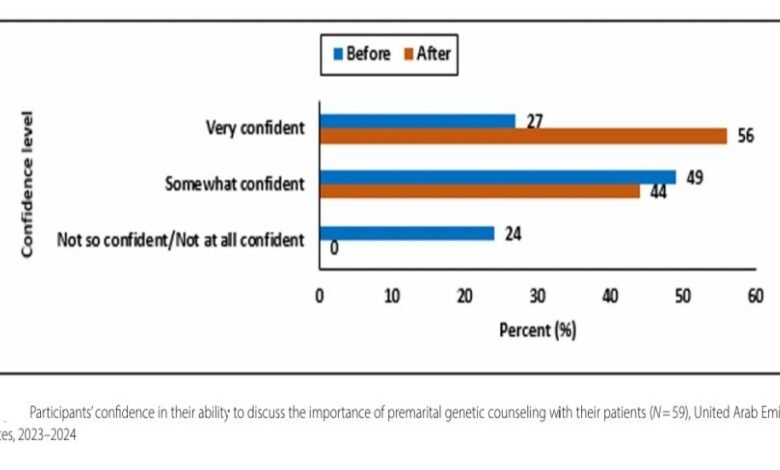
The intervention resulted in significant increase in overall knowledge scores, which rose from a pre-workshop mean of 45% to 77%. This improvement was consistent across all participants, regardless of age, gender, or prior experience. Furthermore, the physicians’ confidence in discussing genetic counselling with patients improved markedly, with those reporting they felt “very confident” rising from 27% to 56%.
Beyond technical knowledge, the workshops facilitated a positive shift in attitudes toward ethical concerns. Participants became less likely to view screening as a violation of personal privacy, with strong disagreement regarding privacy infringement rising from 10% to 42%. Additionally, the belief that screening should be strictly obligatory decreased, indicating a professional shift toward valuing patient empowerment and informed decision-making over mandates
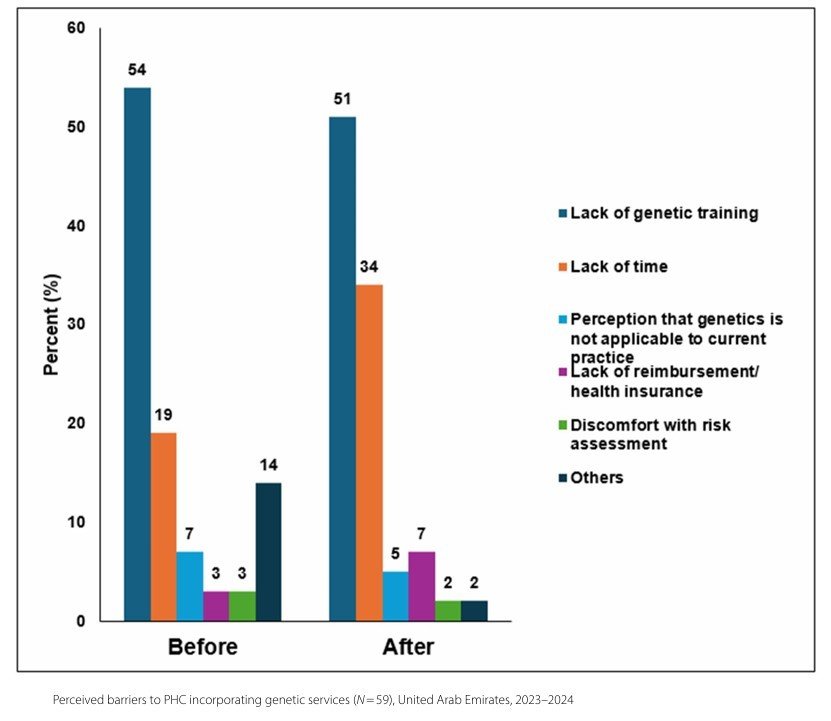
Despite these successes, participants identified the lack of foundational genetic training and time constraints during consultations as persistent barriers to integrating these services into primary care.
The study shows that sustainable and continuous educational interventions for physicians regarding the importance of genetic screening and counselling are therefore vital. Primary care physicians should also have access to evidence-based guide lines for counselling consanguineous couples.
The study concludes that the long-term success of the PMS program hinges on addressing workforce shortages, ethical complexities, and cultural dynamics. By adopting a lifecycle approach, from premarital screening to prenatal diagnostics, the UAE can model a comprehensive strategy for high-consanguinity populations worldwide.
Reference Source:
Rahma, A. T., Allam, M., Amoodi, H., Abdullahi, A. S., Alameri, M. S., Abdulrahman, W. M., Al Jasmi, F., & Al Saffar, M. (2025). Evaluating knowledge enhancement and attitudinal shift among physicians participating in capacity building workshops on expanded premarital screening in the United Arab Emirates: a cross-sectional study. Human Genomics, 19(128). https://doi.org/10.1186/s40246-025-00833-713131313.