


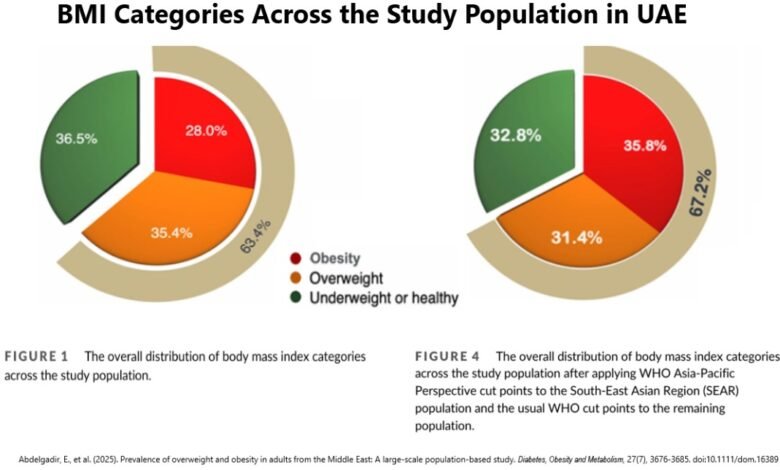
A landmark study involving over 440,000 adults conducted in UAE has revealed that 63.4% of the total population in UAE was either overweight or obese.
This cross-sectional, multi-centre design, population-based study analyzed data of all adults aged >18 years who attended the Dubai Academic Health Corporation (DAHC) between January 2018 and August 2023.
Overweight and Obesity (OAO) was defined according to World Health Organization standards, where underweight is a BMI < 18.5kg/m2, normal is a BMI of 18.5–24.9 kg/m2, overweight is a BMI of 25.0–29.9 kg/m2, obesity class I is a BMI of 30.0–34.9 kg/m2, obesity class II is a BMI of 35.0–39.9 kg/m2, and obesity class III is a BMI ≥40.0 kg/m2. The results are as follows
There is a very high prevalence of overweight and obesity in UAE
- 63.4% of the total population were living with either overweight or obesity.
- 35.4% of participants were classified as overweight
- 28.0% as obese.
There are significant disparities in OAO across nationalities. There breakdown of overweight and obesity OAO across nationalities is as follows:
- 68.3% of UAE nationals
- 59.7% of expatriates from South-East Asian Region (SEAR) countries
- 63.6% of expatriates from other regions
Impact of Sex and Age
- Men were more likely to be overweight (40.0% vs. 30.7%)
- Women had a significantly higher prevalence of obesity (30.4% vs. 25.9%)
- Approximately 50% of female UAE nationals aged 40 or older were living with obesity, and one in five had class II or class III obesity (associated with the worst outcomes).
- Factors contributing to this may include physiological changes during menopause, lower physical activity levels, and cultural practices such as multiparity.
- Despite women being more motivated to seek treatment, men often show better outcomes, suggesting the involvement of gender-specific barriers and cultural factors
Application of modified ethnicity-specific cut points for South-East Asian residents
South-East Asian residents (SEARs) make up a large part of the UAE population. Traditional BMI scales are often based on Western populations whereas individuals of Southeast Asian descent often have higher body fat percentages at lower BMIs as compared to White populations. On applying ethnicity-specific thresholds for South-East Asian residents:
- Obesity rate for SEARs increased from 18.8% to a staggering 59.7%
- Overall UAE obesity prevalence from 28.0% to 35.8%
Applying the Lancet Diabetes & Endocrinology Commission’s (2025) new diagnostic framework for clinical obesity
The new Lancet Commission framework shifts away from BMI-only metrics, instead defining “clinical obesity” as the presence of both excess adiposity and evidence of organ dysfunction or mobility limitations.
This study evaluated the real-world application of the new diagnostic framework for obesity. Using a dataset of over 238,000 individuals, researchers applied these criteria relying on ICD-10 codes to identify clinical obesity. The results highlighted a significant gap between traditional and new diagnostic models. Even at very high BMIs (>40\kg/m2), only 31.2% individuals met the new clinical criteria. In the overweight and Class I/II obesity categories, clinical obesity prevalence ranged from roughly 20% to 28%. The researchers noted that relying on ICD-10 codes likely underestimates end-organ disease.
The study’s data suggests therefore supports some of the concerns around using the new framework and suggests that the new definition might disqualify patients who would otherwise benefit from early intervention.
This is especially true for UAE, where despite the high prevalence of OAO classified according to traditional (BMI-based) and clear management guidelines, only a fraction of individuals receive the necessary assistance and treatment. In an analysis of over 90,000 patients with OAO, 90% of patients had no documented record of a weight management intervention. Even when patients access specialist weight management services, only a third attend, and up to 80% fail to complete treatment.
Conclusion
This comprehensive study on obesity identifies the high-risk groups as older UAE national women and Southeast Asian expatriates and shows that it is imperative to use ethnicity-specific BMI cut-points in clinical practice. It also provides some of the first data on the application of new diagnostic criteria of clinical obesity and suggests that this approach could disqualify some individuals from therapy who might otherwise benefit from a more patient-centric approach. The authors emphasize the need for a patient-centric approach that considers functional and psychological impairments, especially for older female UAE nationals.
Article edited and summarized by Amal Ashraf
Reference Source: Abdelgadir, E., Rashid, F., Bashier, A., Zidan, M., McGowan, B., & Alawadi, F. (2025). Prevalence of overweight and obesity in adults from the Middle East: A large-scale population-based study. Diabetes, Obesity and Metabolism, 27(7), 3676-3685. https://doi:10.1111/dom.16389
Read more articles on public health at https://menamedicalresearch.com/news/category/public-health/