

Type 2 Diabetes in MENA Region – more than 1 in 10 adults are living with Type 2 Diabetes

There has been a tremendous surge in prevalence of Type 2 Diabetes in MENA region. The age-standardized prevalence of T2DM in the MENA region has climbed from 5.57% in 1990 to 11.51% in 2023, indicating that more than 1 in 10 adults in the region are currently living with diagnosed or undiagnosed Type 2 Diabetes.
These are some of the key findings of a comprehensive secondary analysis of the Global Burden of Disease (GBD) datasets from 1990 and 2023 published in International Journal of Public Health.
While advances in clinical therapeutics and healthcare access including the expanded availability of SGLT2 inhibitors and GLP-1 receptor agonists have likely helped stabilize age-standardized mortality 30.16 deaths per 100,000 in 2023, the non-fatal disability burden (measured in Disability-Adjusted Life Years, or DALYs) associated with Diabetes in MENA region has surged dramatically, particularly among the male population and consistently exceeds global benchmarks.
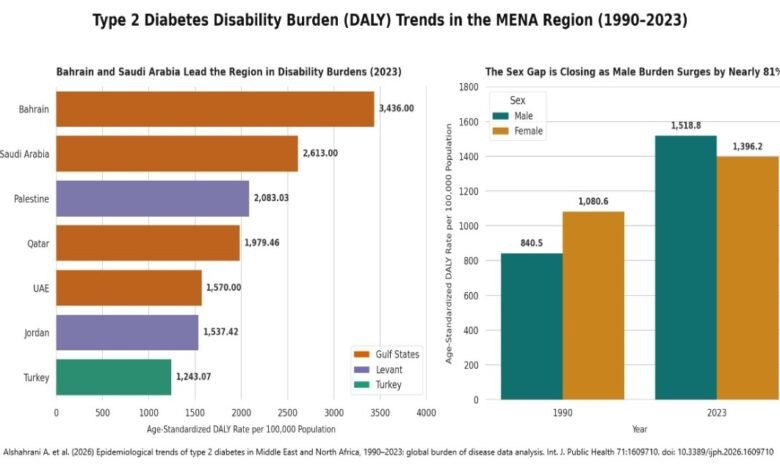
Disability-Adjusted Life Years (DALYs) for males skyrocketed by nearly 81%. In contrast, female DALY rates grew by 29%. This divergence has significantly narrowed the historical sex gap in diabetes-related disability. Researchers note that the elevated male burden, especially in the Gulf states, is partially influenced by a large influx of male expatriate workers who face unique occupational and metabolic risks.
The comprehensive Type 2 Diabetes in MENA burden masks highly diverse country-specific epidemiological trajectories. A clear sub-regional disaggregation reveals that high-income, rapidly developing GCC nations face the most severe burdens. Saudi Arabia and Bahrain exhibit the highest age-standardized DALY rates in the entire region. The 2023 DALY rates represent more than a 100% increase over 1990 baselines (1,207 for Saudi Arabia and 2,710.5 for Bahrain), driven by intense economic transitions, extreme sedentary behaviours, and high rates of generalized obesity.
Table 1: Age-Standardized DALY Rates (per 100,000) for Type 2 Diabetes in MENA Countries
| Country | 1990 DALY Rate | 2023 DALY Rate | Epidemiological Status & Trajectory |
| Bahrain | 2,710.50 | 3,436.00 | Consistently highest burden in the region; sustained upward pressure. |
| Saudi Arabia | 1,207.00 | 2,613.00 | Steepest regional escalation (>100% increase); major public health crisis. |
| Palestine |
1,800.00 – 2,000.00 |
2,083.03 | Elevated chronic burden; stabilized recently after a 2020 peak. |
| Qatar | Peak >2,400.00* | 1,979.46 | Initial surge followed by a downward trend; positive health system response. |
| UAE | 1,085.00* | 1,570.00 | Steady, consistent increase; accelerated growth noted after 2010. |
| Jordan | Peak ~1,900.00* | 1,537.42 | High historical burden; stabilized due to primary care expansion. |
| Turkey | 1,052.54 | 1,243.07 | Stable from 1990 to 2015; entered sharp acceleration phase post-2019. |
Public Health Policy and Strategic Recommendations
The unrelenting growth of the Type 2 Diabetes in MENA region demonstrates that historical and standard preventative frameworks are no longer sufficient to contain this metabolic epidemic. Immediate, targeted interventions are required across all sectors of the health system:
- Deploy Integrated Chronic Care Models: Shift health system focus from acute clinical management to proactive, secondary prevention and comprehensive, long-term diabetes follow-up to curb expanding DALY rates.
- Tailor Culturally Specific Community Interventions: Implement localized, culturally appropriate health campaigns focused on obesity reduction, Westernized dietary transitions, physical activity, and tobacco cessation.
- Improve Early Diagnostic Screening: Enhance diagnostic yield and clinical screening access, particularly for high-risk working-age populations and male expatriates who frequently under-utilize healthcare systems.
- Strengthen Health Information Infrastructure: Establish unified national diabetes registries to systematically track local incidence, assess therapeutic efficacy, and monitor the long-term metabolic impacts of the post-pandemic era.
Source: Alshahrani, A., Aldahash, R., Al-Khateeb, B. F., Alwatban, N., Alhabas, M., Nasser, S., Alnaim, L., & El-Metwally, A. (2026). Epidemiological trends of type 2 diabetes in Middle East and North Africa, 1990–2023: global burden of disease data analysis. International Journal of Public Health, 71, Article 1609710.DOI: https://10.3389/ijph.2026.1609710
Read more on Regional Public Health News https://menamedicalresearch.com/news/category/public-health/