

Strengthening Laboratory Biorisk Mitigation for Emerging Viruses in Limited Resource Settings

Laboratory-acquired infections (LAIs) remain a persistent occupational hazard, particularly as the prevalence of emerging viral diseases has risen over the last two decades. A recent review in the MENA Journal of Bioscience Research highlights a significant “disconnect” between international biosafety standards and their real-world application in low- and middle-income countries (LMICs). While global frameworks are comprehensive, strengthening laboratory biorisk mitigation in these regions is often hampered by resource constraints, infrastructure limitations, and gaps in workforce training.
The Role of Biorisk Assessment and Management
Biorisk assessment is the foundational process used to identify hazards and determine the necessary containment levels for emerging pathogens. This systematic approach involves:
- Hazard Identification: Analyzing a virus’s pathogenicity, infectious dose, and transmission routes.
- Procedure-Specific Evaluation: Identifying risks associated with aerosol-generating tasks like pipetting or centrifugation.
- Mitigation Controls: Selecting appropriate Biosafety Levels (BSLs) and engineering controls, such as HEPA-filtered ventilation and non-porous work surfaces.
Bridging the Gap: Enhanced BSL-2
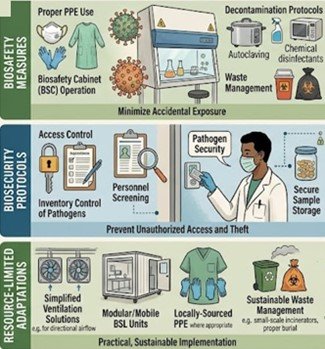
A critical strategy for resource-limited environments is the implementation of enhanced BSL-2 (BSL-2+) protocols. This framework acts as an operational bridge, applying BSL-3-level personal protective equipment (PPE)—such as N95 respirators and wrap-around gowns—and stricter operational procedures within an existing BSL-2 facility. This allows for safe initial diagnostic work on higher-risk agents when access to high-containment BSL-3 or BSL-4 laboratories is unavailable.
Biosafety vs. Biosecurity
The review emphasizes that biosafety and biosecurity are complementary frameworks:
- Biosafety focuses on preventing accidental exposure or release of harmful pathogens through integrated safety procedures and containment equipment like Biosafety Cabinets (BSCs).
- Biosecurity aims to prevent the intentional misuse, theft, or unauthorized access to biological materials through physical security, inventory control, and personnel screening.
Conclusion
Safeguarding against LAIs and the evolving threat of emerging viruses requires a shared commitment from individual technicians, institutional committees, and national governments. Strengthening the safety culture, investing in context-appropriate infrastructure, and maintaining robust waste disposal and spill management protocols are essential for global health security.
Reference:
Kalam, A., Yahya, S., Hussain, J., Azhar, R., & Usmani, A. A. (2026). Strengthening Laboratory Biosafety and Biosecurity in BSL Settings: Biorisk Mitigation Strategies for Emerging Viruses in Limited-Resource Environment. MENA Journal of Bioscience Research, 1(1). Doi: 10.64913/mmrmjbr.vli1.19