

Axial Spondyloarthritis in Arab Countries – Clinical Phenotypes, Disease Burden, and Inter-regional Disparities

A landmark multinational study on Axial Spondyloarthritis in Arab Countries published in RMD Open Clinical uncovers the clinical phenotypes disease burden, and inter-regional disparities.
The Profile of Axial Spondyloarthritis in Arab Countries (PROSPA) study, has provided the most comprehensive evaluation to date of axial spondyloarthritis (axSpA) across the Arab world. Conducted by the ArLAR Research Group (ARCH), the cross-sectional study evaluated 1,112 adult patients across 33 tertiary rheumatology centers in 15 countries spanning North Africa, the Levant, and the Gulf regions.
High Burden of Radiographic Disease and Extra-Articular Features
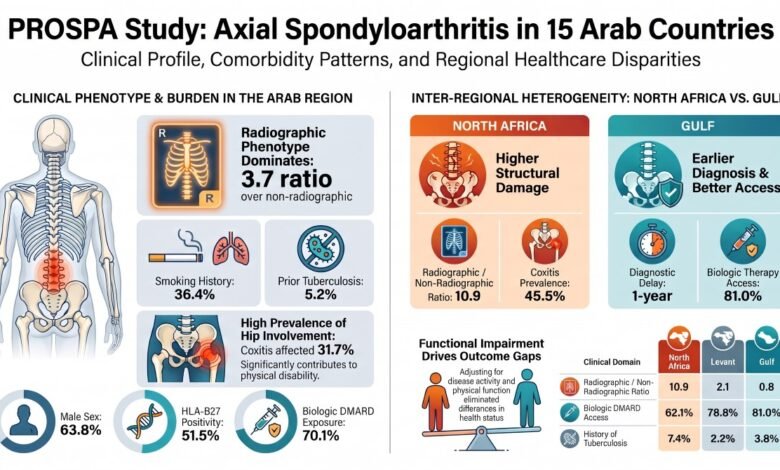
The study cohort (mean age 42.6 years, 63.8% male) presented with long-standing disease (median duration 10.0 years) and a median diagnostic delay of 3.0 years. Researchers observed a heavy predominance of radiographic axial spondyloarthritis (r-axSpA), which accounted for 62.3% of cases, compared to 16.9% for non-radiographic axSpA (nr-axSpA), yielding an overall r-axSpA to nr-axSpA ratio of 3.7.
The overall clinical burden was marked by extensive joint and tissue involvement. Peripheral arthritis was present in 45.7% of patients, while coxitis (hip joint disease) affected 31.7%.
Extra-musculoskeletal manifestations were frequently documented, including psoriasis (17.4%), uveitis (16.7%), and inflammatory bowel disease (8.5%).
HLA-B27 positivity was recorded in 51.5% of tested patients. Furthermore, the cohort presented a distinct comorbidity profile, featuring high rates of smoking (36.4%) and a notable history of tuberculosis (5.2%), underscoring critical safety requirements for pre-biologic screening in the region.
Profound Inter-Regional Heterogeneity
The study also identified striking phenotypic and therapeutic variations across the three subregions, despite similar overall disease activity levels:
- North Africa (53.9% of cohort): Exhibited severe structural damage (highest r/nr ratio of 10.9), elevated rates of coxitis (45.5%), longer diagnostic delays (median 4.0 years), and the highest prevalence of past tuberculosis (7.4%). However, biologic disease-modifying antirheumatic drug (bDMARD) access was lowest here at 62.1%.
- The Gulf (14.3% of cohort): Displayed a reverse pattern with a female majority (60.4%), a lower r/nr ratio (0.8), shorter diagnostic delay (median 1.0 year), and significantly higher bDMARD uptake (81.0%), alongside higher rates of metabolic comorbidities like obesity and dyslipidemia.
- The Levant (31.8% of cohort): Occupied an intermediate clinical and therapeutic profile across most parameters.
Upstream Drivers and Future Outlook
Crucially, multivariable linear mixed-effects modeling demonstrated that geographic sub-region was not an independent predictor of overall health status (ASAS-HI) after adjusting for disease activity and physical function. Instead, disease activity (ASDAS) and functional impairment (BASFI) accounted for most of the explained variance in health outcomes. This indicates that regional health disparities stem primarily from modifiable downstream consequences of diagnostic delay, structural damage, and unequal treatment access rather than intrinsic geographic factors.
To bridge these gaps, the authors advocate for region-specific Arab management guidelines for axial spondyloarthritis, enhanced early referral pathways, targeted smoking cessation programs, and expanded access to biologics and cost-effective biosimilars in underserved areas.
Source: Ziade N, Abou Abdallah F, Kfoury R, et al. Clinical phenotype, disease burden and interregional heterogeneity of axial spondyloarthritis in 1112 patients across 15 Arab countries: the PROSPA study. RMD Open 2026;12:e007136. doi:10.1136/rmdopen-2026-007136
To read more non-communicable diseases research: https://menamedicalresearch.com/news/category/non-communicable-diseases/