

Diagnostic Precision of QuantiFERON-TB Gold Plus – comparison against Mycobacterial cultivation and amplification

Diagnostic Precision of QuantiFERON-TB Gold Plus (QFT-Plus) Immunoassay was benchmarked against Mycobacterial Cultivation and Nucleic Acid amplification in a retrospective evaluation published in Microorganisms.
Conducted at MDLab Central Laboratory in Riyadh, Saudi Arabia, the study analyzed 187 unique patients who underwent concurrent QFT-Plus immunoassay (a fourth-generation interferon-gamma release assay (IGRA)) alongside mycobacterial culture (MGIT 960 and Löwenstein–Jensen) or GeneXpert MTB/RIF molecular testing between December 2024 and December 2025.
Core Diagnostic Performance and Biological Dynamics
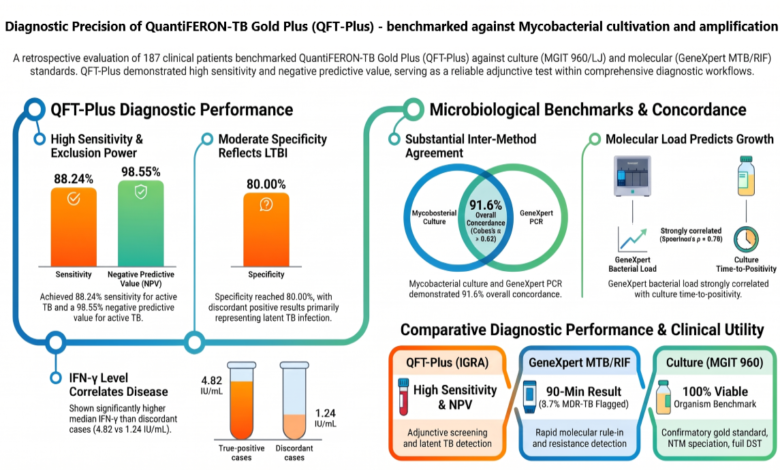
Of the 187 patients evaluated (mean age 49.7 ± 21.9 years; 53.5% male), 17 (9.09%) achieved microbiological confirmation of active tuberculosis. QFT-Plus demonstrated a sensitivity of 88.24% (95% CI: 65.66–96.71%), accurately detecting 15 out of 17 active cases. The assay demonstrated an exclusion specificity of 80.00% (95% CI: 73.35–85.32%) and an exceptionally high negative predictive value (NPV) of 98.55% (95% CI: 94.87–99.60%), underscoring its strength as an adjunctive rule-out test for active TB in routine clinical settings. Overall diagnostic accuracy reached 80.75% with fair-to-moderate agreement (Cohen’s κ = 0.3694).
However, the positive predictive value (PPV) stood at 30.61%, reflecting a key biological limitation of IGRAs. QFT-Plus quantifies host cell-mediated immune responses to M. tuberculosis-specific antigens across both CD4+ and CD8+ T-lymphocytes. Because T-cell memory persists across the continuum from latent infection to active disease, the assay cannot independently distinguish between latent tuberculosis infection (LTBI) and active disease. The 18.2% rate of QFT-positive/microbiologically negative cases (34 of 187 patients) represents true detection of underlying LTBI rather than test failure.
Quantitative Insights and Benchmark Comparisons
The study revealed that quantitative interferon-gamma (IFN-γ) release magnitudes offer valuable predictive context. Patients with confirmed active TB exhibited significantly higher median IFN-γ responses (4.82 IU/mL) compared to discordant LTBI cases (1.24 IU/mL, p < 0.001). Exploratory ROC analysis indicated that applying a higher quantitative threshold (0.52 IU/mL versus the manufacturer’s 0.35 IU/mL standard) could elevate the PPV to 40.4% while maintaining an NPV of 98.7%. Additionally, 86.7% of active TB cases demonstrated higher responses in the CD4+/CD8+ dual-stimulation tube (TB2) than the CD4+ only tube (TB1), highlighting CD8+ T-cell involvement in active infection.
Benchmarking microbiological methods, GeneXpert molecular testing and liquid culture showed 91.6% overall concordance (Cohen’s κ = 0.62). GeneXpert cycle threshold values correlated inversely with culture time-to-positivity (Spearman’s ρ = 0.78, p < 0.001), validating semi-quantitative molecular reporting as a reliable indicator of mycobacterial disease burden.
Clinical Recommendations
The authors recommend integrating QFT-Plus into multimodal diagnostic algorithms tailored to pre-test probability. A negative QFT-Plus result effectively helps rule out active TB in low-to-intermediate suspicion cases, whereas positive IGRA results mandate confirmatory microbiological and radiological evaluation before initiating active TB therapy
Source: Ahmed J. Alzahrani, Monirah Y. Aldamegh, Fizza Khalid, Khalid Sumaily, Samia T. Al-Shouli, Eyad Yousef Abu Sarhan, Moath Mahmoud Abuizghreet, Nouf K. Alrakaf, Ahmed Al-Akedi, Omar Al Mugren 2 and Osamah T. Khojah. Microorganisms (2026). https://doi.org/10.3390/microorganisms14112503
For more regional research on infectious diseases, visit: https://menamedicalresearch.com/news/category/infectious-diseases/