

Five year trend of Antimicrobial Resistance in Klebsiella pneumoniae isolates in Saudi Arabia (2020-2024)

Five year trend of antimicrobial resistance in Klebsiella pneumoniae isolates in Saudi Arabia has been reported in a study conducted by researchers at Dr. Sulaiman Al Habib Medical Group and King Saud University.
The study analyzed 2,014 non-duplicate clinical isolates collected between 2020 and 2024 at a tertiary care hospital in Riyadh.
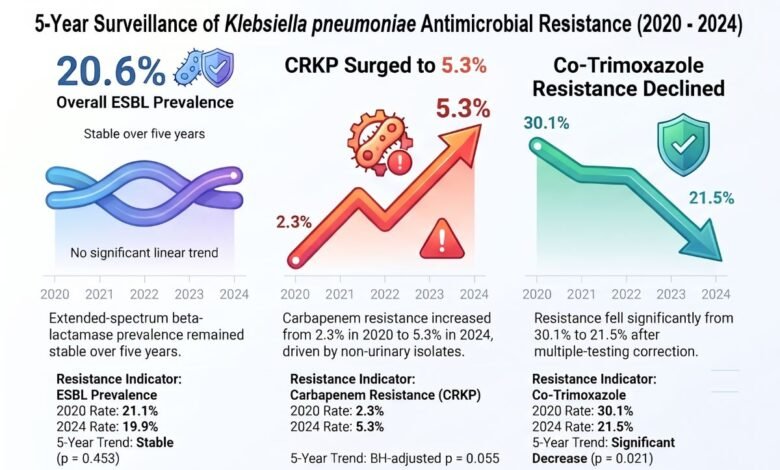
Across the five-year cohort, extended-spectrum β-lactamase (ESBL) phenotypes were detected in 20.6% of isolates (415 cases). Annual ESBL rates remained stable, ranging from 18.3% to 23.1% without a significant linear trend (p = 0.453). Overall prevalence of carbapenem-resistant K. pneumoniae (CRKP) stood at 2.7% (55 isolates).
However, individual resistance to imipenem and meropenem increased from 2.3% in 2020 to 5.3% in 2024. While endpoint comparisons between 2020 and 2024 showed a statistically significant increase (p = 0.032), the five-year linear trend did not maintain statistical significance after Benjamini–Hochberg multiple-testing correction (BH-adjusted p = 0.055). The authors highlight that while this 2024 rise does not confirm a monotonic trend, it represents a crucial surveillance signal requiring close follow-up.
In contrast to carbapenem trends, co-trimoxazole demonstrated a statistically significant linear decrease in resistance, dropping from 30.1% in 2020 to 21.5% in 2024 (BH-adjusted p = 0.021). It was the only agent among 12 tested antimicrobials to exhibit a significant temporal reduction.
Aminoglycosides retained high in vitro activity, with annual resistance remaining low for amikacin (≤2.6%) and gentamicin (≤5.9%). Resistance to common first-line β-lactams, such as amoxicillin-clavulanate (30.1%–35.8%) and ceftriaxone (20.9%–25.6%) remained substantial throughout the study.
Multivariable regression analysis revealed a substantial disparity in resistance profiles based on patient setting. After adjusting for study year and specimen source, inpatient status was independently associated with higher resistance across all 12 evaluated antimicrobials (p < 0.001). Hospitalized isolates showed marked odds of resistance, with adjusted odds ratios reaching 10.56 for amikacin, 10.33 for meropenem, and 9.72 for imipenem compared to outpatients.
Specimen origin also significantly influenced resistance distribution. Urinary specimens predominated (73.5% of isolates) and maintained low carbapenem resistance (1.5%). Conversely, bloodstream (14.3%) and respiratory (13.0%) isolates exhibited far higher carbapenem resistance rates. Analysis showed that the 2024 CRKP signal was primarily driven by non-urinary sources, particularly wound/soft-tissue specimens (which reached 15.6% resistance in 2024).
Clinical & Policy Implications The lower overall resistance rates in this hospital compared to other regional tertiary institutions (where CRKP prevalence has exceeded 30% to 50%) stem largely from a higher proportion of outpatient and urinary samples. The authors conclude that setting- and specimen-informed antibiograms are essential for guiding empirical therapy, supporting antimicrobial stewardship, and mitigating hospital-associated transmission.
Source: Fizza Khalid, Ahmed J. Alzahrani, Majed Alabdulhafid, Gharam Alruwaili, Nouf Alrakaf and Osamah T. Khojah. Five-Year Trends in Antimicrobial Resistance and Carbapenem Resistance Among Klebsiella pneumoniae Isolates in Saudi Arabia. Antibiotics (2026) https://doi.org/10.3390/antibiotics15111062
For more regional research on infectious diseases, visit: https://menamedicalresearch.com/news/category/infectious-diseases/